Our Application Platform
We have adopted the Microsoft Azure platform for our development, and use Python for our primary development language.
Transcript
We know our clients come to us for consistent, reliable business applications and
agents.
Today, anyone can make an app but if keeping your customers satisfied depends on the
app, you can depend on us.
We ensure speed, quality and reliability by keeping our set of tools small.
That's why we stick to Microsoft Azure and Python.
We know our clients come to us for consistent, reliable business applications and
Consistency = Speed and Quality
We are a small team, so I don't like to spread ourselves too thin. We might elect to use some other system components in the future, but I have found the manageable footprint on Azure helps us be consistent, rigorous and more productive.
Microsoft Azure
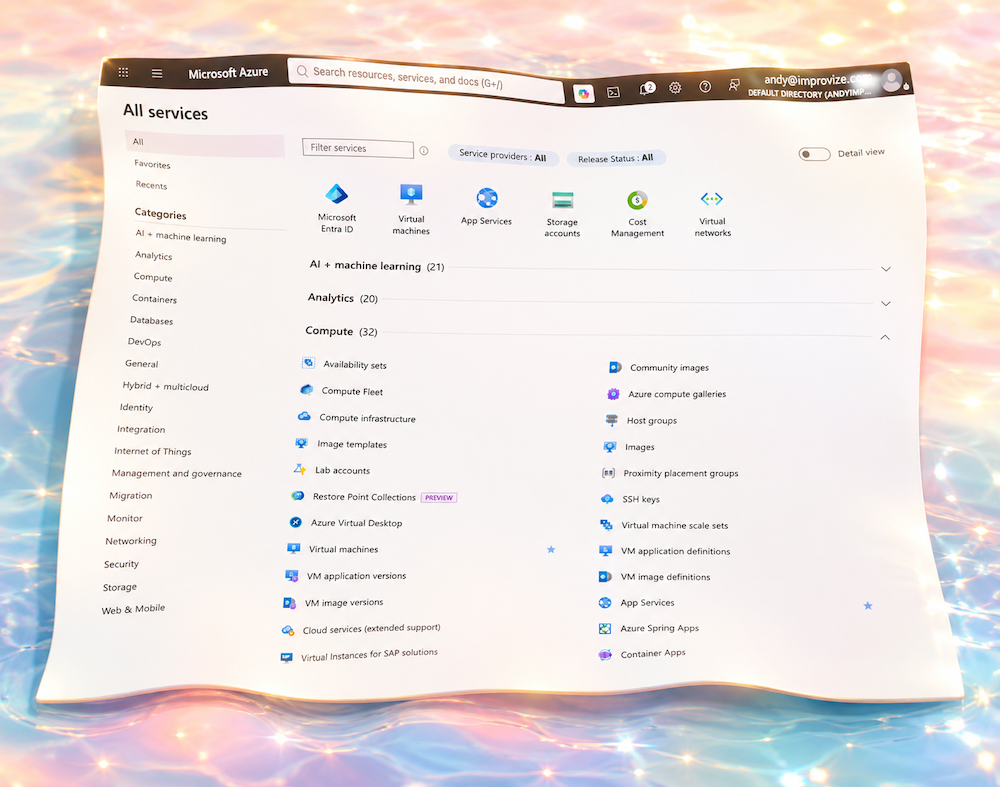
Microsoft has done a good job of giving developers are comprehensive and flexible space on which to build and manage applications. We routinely use the following Azure services:
- App Service or Container Apps
- Cosmos DB
- Azure Blob Storage
- Email Communication Service
- Azure AI Foundry
Python Flask Apps
Web apps built using Flask have turned out to be versatile and easy to maintain. We constrain ourselves a bit on scalability, but this has not be an issue on our projects.
We use Github and deploy using Github Actions to Azure.
Coding Agents
We primarily use Codex (OpenAI) but also occasionally use Claude Code (Anthropic).
- write complex assignments into a
.md markdown file - always ask for a plan first; save the plan back to the .md file
- ask for an html mockup so you can correct "misunderstandings"
- the .md files are both design and implementation docs
LLM models
We keep up with the latest models. Microsoft AI Foundry gives us a consistent way to deploy and handle billing for our LLM subscriptions. Presently we're using:
- OpenAI GPT 5.6
- Claude Opus 4.8
- Azure Text to Speech